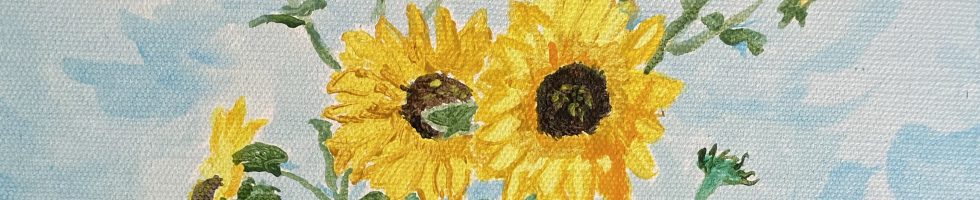
Near the entrance a young man stood – a very youthful looking fellow – and stared at Jules across the way. Probably at the ever-blooming red carnation and the curls draping her shoulders. He looked over at Sue too, for a split second, not enough time to see past her glasses. Sue’s lips were painted ruby red like the color of the carnation, with the kind of lipstick that stays on the lips for a whole day. She wore a pale yellow scarf around her neck, probably because of the cold weather, but also to cover what she called crow’s feet on her neck. But rather than commenting on any of this attire, the stranger at her side said, I like your glasses. Sue said nothing and wondered what it was about her glasses there was to like. They were like any other pair of glasses. Yes, the frames had a subtle purple tint, but this was nothing out of the ordinary. She removed them from her face and wiped the lenses with the napkin that had been wrapped around her glass. The young man from the entrance now stood behind, so close she could feel his cool breath on the back of her neck. If her ears were conch shells, this young man at an advantage could lean in, and when he did he would hear erotic phrases, musings of a theorist set to violin music, the echoes of a poet’s address.
Bag My Bones
22 Jan 2012 Leave a comment
She said – perversely – that she would not love me, not in this world nor the next. That she cannot accommodate loose teeth or a bum knee.
True – my teeth will fall and my good knee will soon give way like the other, but these and this won’t matter in the next world belonging to eternity.
I tell her – this world belongs to corruption and my ailing parts provide testimony. Death is part of the natural rhythm of things. If you take my hand now, we will enter incorruption together.
She is not convinced.
She has chosen that strong, hard body over there, for its pleasures. She will leave it before it shifts shape in the mirror. She will keep it until she gets her full.
I bag my bones and rattle them in her hearing. I paint a picture and then another. I save my everlasting picture for the blind. They are always hungry.
18 Jan 2012 1 Comment
Father said, “You’re never freer than when you bask in the wide open, under the sun, amidst the trees.”
I’ve tried what you said Father, but the sun and trees have paid no mind. Not even when I shoved a shovel into the earth and stuffed it with lifeless things.
Not even when I lay on the grass under nothing but the sun for hours with disrespectful ease.
Nobody’s watching me.
The blinds behind my bed are broken – they open only partially.
Yet, I feel the warmth that comes from the sun. I have felt it sporadically
since – I remember – burning my cheeks and eyes through the first-grade window.
I sit in this bedroom as I have for dozens of seasons,
rise to the same clamor of dishes, answer to the same holler of my name through an open or closed hallway door.
Nobody’s watching me.
The doors, windows and floors filter the voices and faces
so that what I fear most – losing you – has always already been.
In the design.
Beckett and Woolf
11 Jan 2012 Leave a comment
They posed for the sake of the shoulder. They saw it odd to stare straight and smile, waiting for a flash like we do these days (we don’t mind the blind). He might have combed his hair with his fingers first (his wavy white and gray). She might have smoothed her skirt (even though it would never appear). One cannot think of her own death when posing (unless she’s prepared). He got it right after the second try. She the first (her parted lips start to say ‘I don’t have all day.’) I want to wear my hair like hers (it takes great care to wear one’s hair loosely so that it uncoils slowly through the day). I want to navigate the straits of his face into that wide foaming open. I want to see myself the way others would dream me and then look away.
 The Hungry Artist