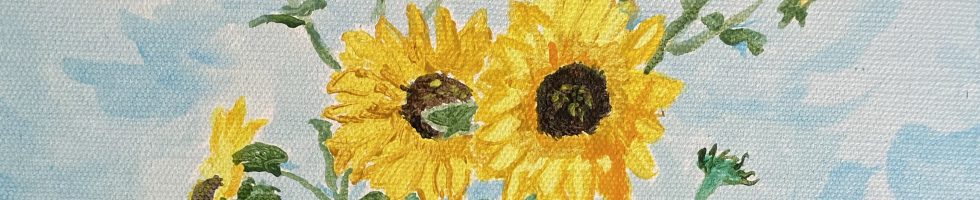
“starry sky…always in mind”
stretched over and under anything you
could never imagine in its vastness
more eternal than the sower and his corn
in the way it needs no human hand
to endlessly gather the crows
One More for Van Gogh
14 Feb 2012 Leave a comment
Purchase my novel, The Former Things Have Passed Away, in paperback!
08 Feb 2012 1 Comment
My first novel, The Former Things Have Passed Away, is now available as a lovely 236-page paperback with my own personally-designed cover at Create Space! You can purchase it at the link below:
https://www.createspace.com/3790463
It is also available for purchase at Amazon.com at the following link:
http://www.amazon.com/Former-Things-Have-Passed-Away/dp/1470028743/ref=sr_1_2?ie=UTF8&qid=1328834659&sr=8-2
Three chapters have been separately published as stand-alone pieces,the publishing information available in my bibliography. Here is a brief excerpt from the opening chapter:
2000
The big green sign says, A Special Place to Remember. I remember. I remember many things. With the windows down, the breeze, say goodbye, say goodbye. I can’t forget. Because of that sign. Or the hum of the radio – say goodbye. Or maybe it’s this breeze, cooling my hot flushed face with ease. The mind likes to remember things – like – a Tuesday morning. A quarter to nine. A phone call. Ring, ring. “She’s gone.” The round white clock hanging on the wall with its clear black numbers and arrows.
This song is fading. I step out onto the blacktop and get mud all over my shoes. I wipe them off on the wet grass.
There’s a new bench marker here on the hill: Lee & Chang Family Bench. This other one just says, Young, squared off with yellow caution tape, like a fresh crime scene. Still I can read the inscription: 1930-1995. Hers reads: Josephine Cabrera, Beloved Wife and Mother, 1940-1998. ‘Young’ was 65. She was only 58. Maybe it’s okay to die at 65, but not at 58. Now that’s a crime.
There aren’t any trees up here on the incline. No shade. There are fresh bouquets, mini-candles, lanterns, orange and yellow bloated smiley faces, butterflies. There are red, white and blue flags, pinwheels swirling yellow and blue and red. Fake plastic flowers, like the ones Papa leaves between fresh flower changes. I’ve been here dozens of times, and yet I can never remember exactly where her marker is, hidden somewhere under this spectacle of vibrant, rich color. Somewhere halfway-down the hill, neither highly sloped, nor completely level. If I squint and peer deeper, maybe I can distinguish Papa’s fake flowers from the real, or freshly laid, or dying.
A Tuesday morning, a quarter to nine. I had just gotten out of the shower after two unwashed days in the hospital. The phone rang. It rang and rang, and no one ran to answer it. And then I finally picked up the receiver. Tina, she’s gone.
*Thanks in advance for your support!
05 Feb 2012 2 Comments
pen in hand –
held between thumb and index finger
swirling down the space between
two definite lines
sometimes over and sometimes under
chasing the phrase
that is not on the page
something like the opposite of hunger –
constipation – the need
to expel the hell that lingers
when pen pauses in hand –
this is how I’ll always remember her –
absolute resilience in the face
of having nothing
of significance
to say
For Van Gogh
03 Feb 2012 Leave a comment
Sunrise. Sunflower. Unblinking eye.
(She scrubs the toilet with splashes of pine sol. She dips the scrubber into the polished water to drench the bathroom tile. Lunch is take-out. Dinner is homemade pea soup and leftover apple pie. She pulls her shirt off in front of the mirror and jiggles her breasts. They feel like water balloons. He comes over and they watch a movie together before having wrestling sex. She opens the door for him, and closes it for him, and twists the door chains together. She touches the steel pot to make sure it’s cooled. She lets out her shirt in the bathroom. They still feel like water balloons. She sprays Windex on a paper towel and cleans the mirrors. She uses the used towel to wipe the dust off the trash lid and weight scale. She’s still not sleepy so she watches a 38-minute documentary on the life of a real-life genius. She’s still hungry so she heats up one-third of the leftover pie for half a minute. She washes it down with low-fat milk. She pours 2/3 of a cup of cat food into the cat dish. She faces the sunflower toward the wall.)
Blink slowly. Copycat. Turn out lights. Turn out.
*
She said – perversely – that she would not love me, not in this world nor the next. That she cannot accommodate loose teeth or a bum knee.
True – my teeth will fall and my good knee will soon give way like the other, but these and this won’t matter in the next world belonging to eternity.
I tell her – this world belongs to corruption and my ailing parts provide testimony. Death is part of the natural rhythm of things. If you take my hand now, we will enter incorruption together.
She is not convinced.
She has chosen that strong, hard body over there, for its pleasures. She will leave it before it shifts shape in the mirror. She will keep it until she gets her full.
I bag my bones and rattle them in her hearing. I paint a picture and then another. I save my everlasting picture for the blind. They are always hungry.
*
For this I apologize –
With my vital thumb
I smear away
Your sloping eye and forehead lines –
Accidental features
And leave alone the length
Of your pointer finger
For you my one request –
Press out of existence
My excess flesh
And leave behind
As redress
The essence
Of my figure
And don’t forget –
Wall Crawler (A poem in haiku)
29 Jan 2012 Leave a comment
Spilled milk on carpet
Kitten cradled crux of arm
Sleep comes swift for two
(In the bedroom)
Just like Spiderman
Brother creeps up hallway walls
Above shiny cracked tiles
Slide across in socks
Goggled eyes spy brother reach
Sweet cottage cheese sky
(In the room they sleep indifferently)
Only yesterday
Made brother’s head go knock knock
Hard into the floor
Flip switch at one end
Slide back and flip the other
Out with the nightlights
(So as not to disturb the sleepers)
Brother goes to sleep
In the fetus position
Licking up spoiled milk
(Meanwhile the sleepers continue to sleep)
Forgive them he says
In the language of dreamers
For they know not what
They’ll do in a few
The cracked tile will be replaced
Brother’s head healed
And no one left to climb walls like children.
Excerpt from “The Crash of a Lash”
25 Jan 2012 Leave a comment
Near the entrance a young man stood – a very youthful looking fellow – and stared at Jules across the way. Probably at the ever-blooming red carnation and the curls draping her shoulders. He looked over at Sue too, for a split second, not enough time to see past her glasses. Sue’s lips were painted ruby red like the color of the carnation, with the kind of lipstick that stays on the lips for a whole day. She wore a pale yellow scarf around her neck, probably because of the cold weather, but also to cover what she called crow’s feet on her neck. But rather than commenting on any of this attire, the stranger at her side said, I like your glasses. Sue said nothing and wondered what it was about her glasses there was to like. They were like any other pair of glasses. Yes, the frames had a subtle purple tint, but this was nothing out of the ordinary. She removed them from her face and wiped the lenses with the napkin that had been wrapped around her glass. The young man from the entrance now stood behind, so close she could feel his cool breath on the back of her neck. If her ears were conch shells, this young man at an advantage could lean in, and when he did he would hear erotic phrases, musings of a theorist set to violin music, the echoes of a poet’s address.
Bag My Bones
22 Jan 2012 Leave a comment
She said – perversely – that she would not love me, not in this world nor the next. That she cannot accommodate loose teeth or a bum knee.
True – my teeth will fall and my good knee will soon give way like the other, but these and this won’t matter in the next world belonging to eternity.
I tell her – this world belongs to corruption and my ailing parts provide testimony. Death is part of the natural rhythm of things. If you take my hand now, we will enter incorruption together.
She is not convinced.
She has chosen that strong, hard body over there, for its pleasures. She will leave it before it shifts shape in the mirror. She will keep it until she gets her full.
I bag my bones and rattle them in her hearing. I paint a picture and then another. I save my everlasting picture for the blind. They are always hungry.
18 Jan 2012 1 Comment
Father said, “You’re never freer than when you bask in the wide open, under the sun, amidst the trees.”
I’ve tried what you said Father, but the sun and trees have paid no mind. Not even when I shoved a shovel into the earth and stuffed it with lifeless things.
Not even when I lay on the grass under nothing but the sun for hours with disrespectful ease.
Nobody’s watching me.
The blinds behind my bed are broken – they open only partially.
Yet, I feel the warmth that comes from the sun. I have felt it sporadically
since – I remember – burning my cheeks and eyes through the first-grade window.
I sit in this bedroom as I have for dozens of seasons,
rise to the same clamor of dishes, answer to the same holler of my name through an open or closed hallway door.
Nobody’s watching me.
The doors, windows and floors filter the voices and faces
so that what I fear most – losing you – has always already been.
In the design.
Beckett and Woolf
11 Jan 2012 Leave a comment
They posed for the sake of the shoulder. They saw it odd to stare straight and smile, waiting for a flash like we do these days (we don’t mind the blind). He might have combed his hair with his fingers first (his wavy white and gray). She might have smoothed her skirt (even though it would never appear). One cannot think of her own death when posing (unless she’s prepared). He got it right after the second try. She the first (her parted lips start to say ‘I don’t have all day.’) I want to wear my hair like hers (it takes great care to wear one’s hair loosely so that it uncoils slowly through the day). I want to navigate the straits of his face into that wide foaming open. I want to see myself the way others would dream me and then look away.
Sophie Scholl: The Final Days (German Film)
08 Jan 2012 Leave a comment
I discovered the story of the White Rose Society through the German film Sophie Scholl: The Final Days that I watched on Netflix instant play last night. It was nominated for best foreign language film in 2006 and I can see why. Most of the film is made up of dialogue between Sophie, an anti-Nazi activist and a Gestapo policeman, based on transcripts and letters, etc. discovered in Germany not that long ago. I reflect on this film because I find myself fixated on the idea of the power of ideology (I am nearly done reading Zizek’s The Sublime Object of Ideology) and it never ceases to amaze me how much cruelty and the worst of human behavior stems from mere ideas. This young woman Sophie and her brother, along with several others activists were decapitated for writing and distributing leaflets condemning Nazi Nationalist Socialism and how it was dragging Germany into extreme bloodshed and shame. They were immediately executed after a sham of a trial called the “People’s Court” and I cringed at how the others who watched the trial said nothing, even though I’m certain many of them must have agreed with the White Rose Society’s message. I am impressed at how my attention was captured by almost entire dialogue – a form of ideology in itself. Would I have done what these very young people had done in the face of extreme punishment? At first, Sophie denied everything. But when the Gestapo produced undeniable evidence of her involvement, she went all the way with it, even after being offered a deal that could have saved her life. The most heart wrenching part for me was when her parents visited her in prison before her execution and they said their goodbyes, her father proud that she made the right (conscientious) choice. Was it? She and the other members of the society are now considered some of the greatest heroes of modern-day Germany, and their message has been spread and explored and honored internationally. I recommend watching this film and then researching the information it is based upon. It’s easy to divert our eyes in the face of something so beyond comprehension, but something happens when we force ourselves to do so. Let me know your reaction if you go ahead and explore this film and its story.
 The Hungry Artist